


Old House New Cold and How to Retrofit Without the Ductwork Drama

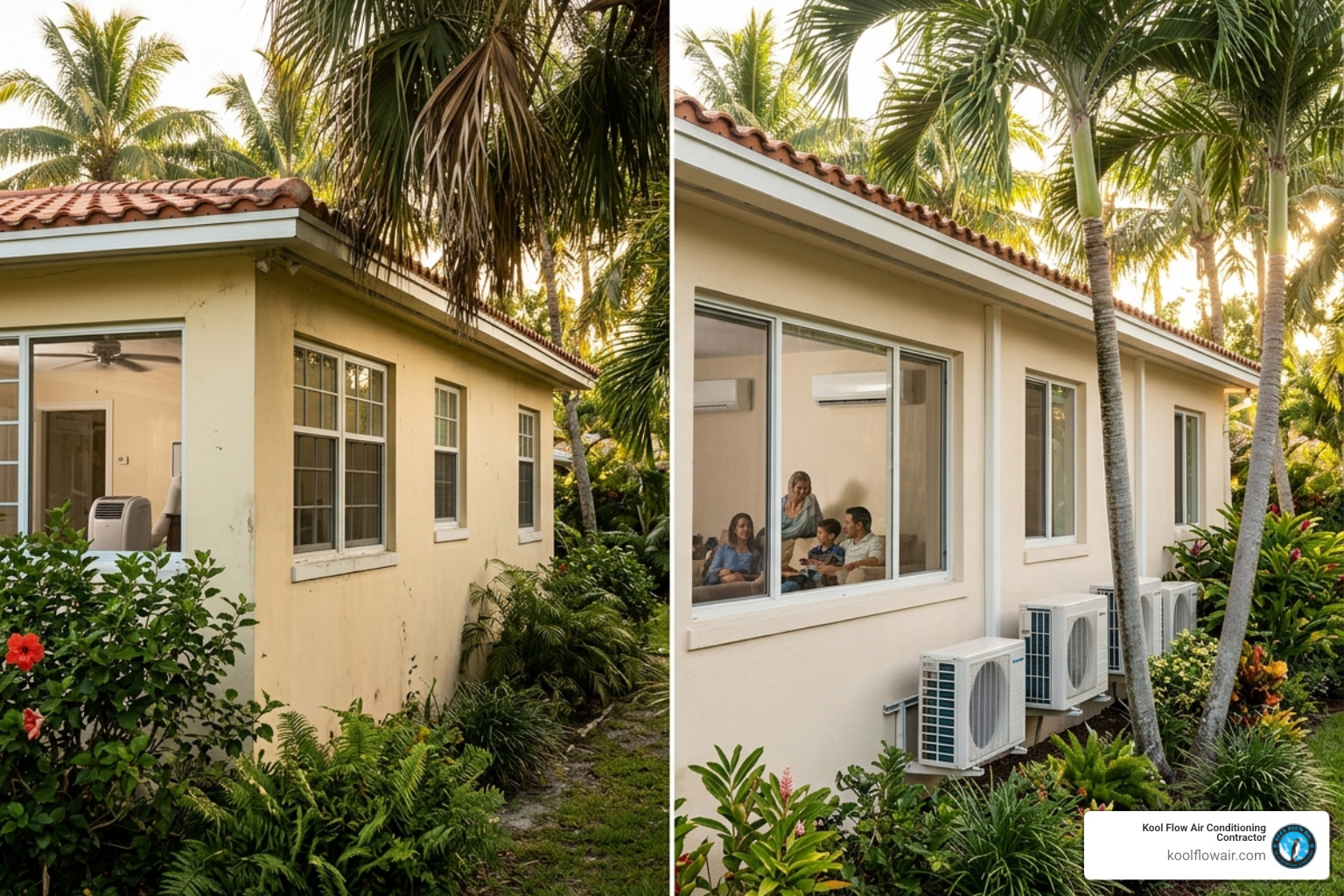
Why Cooling an Older Florida Home Is More Complicated Than You Think
Central air vs mini split for older Florida homes is one of the most common questions South Florida homeowners face — and the answer matters more than most people realize.
Older Florida homes are charming. But they were built long before modern air conditioning existed. That means no ductwork, narrow wall cavities, plaster walls, and tight attic spaces. Forcing a traditional central air system into that kind of structure can get expensive, disruptive, and inefficient fast. Meanwhile, Florida's cooling season stretches 9 months or longer, so whatever system you pick will be working hard — every single day.
Here's a quick breakdown to help you decide:
| Factor | Central Air | Mini Split |
|---|---|---|
| Requires ductwork | Yes | No |
| Best for older homes without ducts | No | Yes |
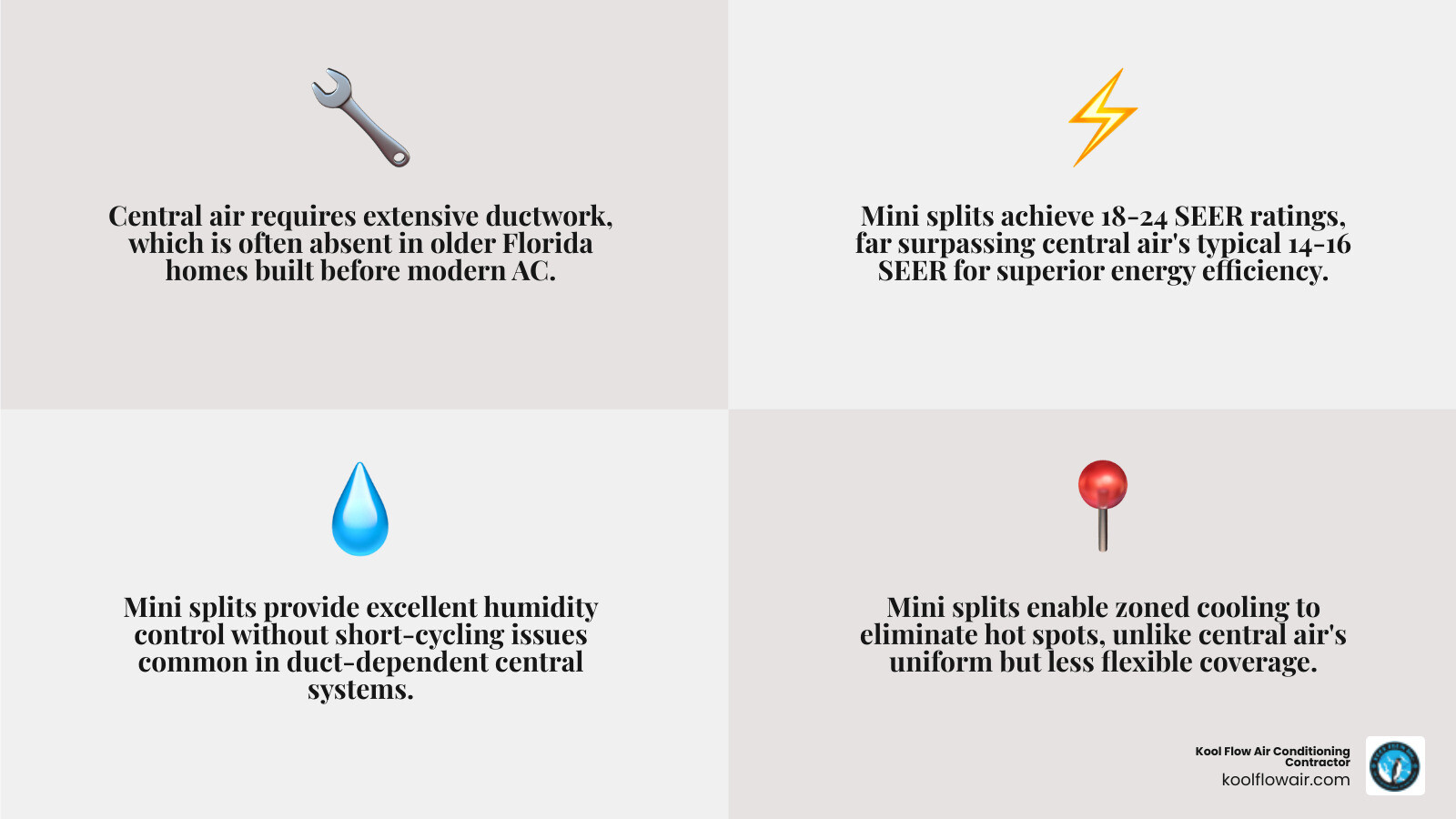
| Energy efficiency (SEER) | 14-16 | 18-24 |
| Duct energy loss | 20-30% | None |
| Zoned cooling | Limited | Yes |
| Installation disruption | High | Low |
| Humidity control | Depends on duct condition | Excellent |
| Whole-home uniform cooling | Yes | Yes (multi-zone) |
The short answer: For most older Florida homes without existing ductwork, a mini split system is the more practical, efficient, and cost-effective choice. Central air still makes sense if your home already has functional, well-sealed ducts and you want uniform whole-home coverage.
Read on for the full breakdown — including what makes Florida's climate a unique challenge, how each system handles humidity, and how to protect your home's historic character during installation.
Central Air vs Mini Split for Older Florida Homes: The Core Differences
When we talk about central air vs mini split for older Florida homes, we are looking at two fundamentally different ways of moving heat out of your living space. Understanding these mechanics is the first step toward reclaiming your comfort during a sweltering July afternoon in South Florida.
Traditional central air conditioning relies on a "split system" consisting of a large outdoor condenser and an indoor evaporator coil, usually housed in a central air handler. The "magic" happens through a vast network of ducts hidden behind your walls or in your attic. This system pulls warm air from every room, cools it at a single point, and then pushes it back through the house. It’s designed for uniformity—one thermostat, one temperature, one massive effort to cool the whole footprint at once.
In contrast, a mini split (or ductless) system skips the "middleman" of ductwork entirely. It uses small, sleek indoor air handlers mounted directly on the walls or ceilings of specific rooms. These units are connected to an outdoor compressor by small copper refrigerant lines and electrical wiring that only require a tiny three-inch opening in the exterior wall.
Because mini splits deliver air directly into the room they are in, they offer what we call "zoned cooling." This means you can keep the kitchen cool while you’re cooking but turn off the AC in the guest room you aren't using. For many residents, especially those looking into AC Installation Pompano Beach FL, this flexibility is a game-changer for both comfort and monthly utility bills.
Preserving Historic Integrity: Why Older Homes Struggle with Ductwork
If you live in a classic 1920s bungalow or a mid-century masonry home in South Florida, you’ve probably noticed something: there isn't much "extra" space. These homes were built for natural ventilation—high ceilings, large windows, and thick walls—not for bulky 12-inch wide metal or flex ducts.
The Drama of Retrofitting Ducts
Adding central air to a home that wasn't built for it often feels like trying to fit a square peg in a round hole. To install ducts, contractors often have to build "soffits" or "bulkheads"—those boxy drop-downs in the ceiling that can ruin the aesthetic of a historic room. You might lose closet space or have to tear into original plaster walls, which is both messy and heart-breaking for fans of historic architecture.
The Duct Loss Problem
Even if you manage to squeeze the ducts in, you face a massive efficiency hurdle. In Florida, ducts are often relegated to the attic. When it’s 95 degrees outside, your attic can easily reach 130 degrees or more. According to the U.S. Department of Energy, central air systems lose 20% to 30% of their conditioned air through duct leaks, loose connections, and heat transfer.
Essentially, you are paying to cool your attic before that air ever reaches your bedroom. Mini splits eliminate this "duct loss" entirely because the cooling happens right at the source. This is a primary reason why many opting for AC Replacement Riverwalk Fort Lauderdale FL are making the switch to ductless technology.
Beating the Florida Heat: Efficiency and Humidity Control
In South Florida, our air conditioners don't just "cool"—they are our primary defense against the oppressive humidity. The battle of central air vs mini split for older Florida homes is often won or lost on how the system handles moisture.
Inverter Technology vs. Standard Cycling
Most traditional central air units operate like a light switch: they are either 100% on or 100% off. When the thermostat hits the target temp, the system shuts down. In our humid climate, this can lead to "short-cycling," where the air gets cool quickly, but the system doesn't run long enough to actually pull the moisture out of the air. This leaves you feeling cold and clammy—the "refrigerator effect."
Mini splits utilize inverter technology. Think of this like a dimmer switch rather than a light switch. The compressor can speed up or slow down to match the exact cooling needs of the room. By running at lower speeds for longer cycles, mini splits are exceptionally good at consistent dehumidification. This steady operation is vital for residents seeking AC Service Pembroke Pines FL to improve their indoor air quality.
Energy Efficiency of Central Air vs Mini Split for Older Florida Homes
Efficiency is measured by the Seasonal Energy Efficiency Ratio (SEER). The higher the number, the less power the unit uses to cool your home.
- Central Air: Typically ranges from 14 to 16 SEER.
- Mini Splits: Commonly range from 18 to 24 SEER, with some high-end models reaching as high as 30.
Because mini splits use 30-50% less energy than traditional units (thanks to the lack of duct loss and smarter compressor technology), the long-term savings can be substantial. For homeowners considering AC Installation Weston FL, these efficiency gains often justify the initial investment in a multi-zone setup.
Humidity Control and Indoor Air Quality
Beyond just cooling, mini splits often feature multi-stage filtration systems that can trap allergens and dust more effectively than a single central filter. Because there are no ducts, you also don't have to worry about dust, mold, or vermin dander accumulating in hidden passages over time. Keeping up with AC Maintenance Fort Lauderdale FL ensures these filters stay clean and your air stays crisp.
Zoned Comfort for Multi-Story and Historic Layouts
One of the biggest headaches in older, multi-story Florida homes is the "hot second floor." Heat rises, and traditional central systems often struggle to push enough air upstairs to keep bedrooms comfortable without freezing out the living room downstairs.
Independent Control
With a mini split system, every indoor unit has its own thermostat. This means:
- Personalized Comfort: The person in the master bedroom can sleep at 68 degrees while the living room stays at a more energy-efficient 75 degrees.
- No More "Thermostat Wars": Zoning allows family members to set their own preferences without affecting the rest of the house.
- Smart Savings: You aren't paying to cool the kitchen and dining room at 3:00 AM while everyone is asleep.
This level of lifestyle flexibility is exactly why we recommend these systems for AC Maintenance Hollywood FL customers who live in older, multi-generational homes where usage patterns vary wildly throughout the day.
Choosing the Right System and Long-Term Maintenance
Whether you choose central air vs mini split for older Florida homes, the longevity of your investment depends on professional installation and regular care. Both systems typically have a lifespan of 15 to 20 years, provided they aren't forced to overwork due to poor sizing or neglected maintenance.
Long-Term Savings and Incentives
While we don't discuss specific pricing, it is important to note that the U.S. Department of Energy highlights that zoned HVAC systems can cut energy costs by about 30%. Furthermore, many Florida residents may be eligible for federal tax credits or local utility rebates when they install high-efficiency heat pump technology, which most modern mini splits use.
The Importance of Maintenance
In our salt-air environment, coils can corrode and drains can clog with algae quickly. Regular check-ups are non-negotiable. Whether it's a central unit or a series of mini split heads, we recommend bi-annual service to keep the system running at peak SEER ratings. For those in more rural or coastal areas, such as AC Maintenance Southwest Ranches FL, this preventative care is the difference between a system that lasts 20 years and one that fails in 10.
Frequently Asked Questions about Florida Retrofits
Why do older Florida homes lack ductwork?
Many historic Florida homes were built in an era of "passive cooling." This involved high ceilings to let heat rise, large wrap-around porches to shade the walls, and windows placed to catch cross-breezes. Because they were often built with solid masonry or lacked the "attic floor to ceiling" clearance found in modern construction, there simply wasn't a physical cavity designed to hold a network of large ducts.
How much energy is lost through leaky ducts?
It is a staggering amount. According to the U.S. Department of Energy, typical duct systems lose 20-30% of the air that moves through them. In Florida, this is exacerbated because ducts often run through unconditioned attics. If your ductwork has gaps or poor insulation, your AC has to run longer and harder just to compensate for the air leaking into your crawlspace or attic.
When is central air still a viable option?
Central air is still a great choice if your home already has a functional duct system in good condition. If you prefer the "invisible" look of vents rather than seeing an indoor unit on the wall, or if you have a very open floor plan where a single large air handler can move air effectively, central air remains a solid, reliable standard for whole-house cooling.
Conclusion
Choosing between central air vs mini split for older Florida homes doesn't have to be a drama-filled ordeal. By understanding your home's unique architecture and your family's cooling needs, you can find a solution that keeps you comfortable without sacrificing the historic charm of your South Florida residence.
At Kool Flow Air Conditioning Contractor, we’ve spent over 20 years helping our neighbors across Broward, Miami-Dade, and Palm Beach Counties navigate these exact decisions. As a family-owned business based in West Park, FL, we pride ourselves on honest guidance and reliable cooling solutions tailored to the Florida climate. Whether you are looking for a high-efficiency mini split for a historic bungalow or a robust central air replacement for a sprawling estate, our team is here to ensure you stay cool for years to come.
Ready to find the perfect fit for your home? Explore our full range of Air Conditioning Services and let us help you beat the Florida heat once and for all.


Hear what our satisfied
clients have to say

SERVICE AREAS