


Why Florida Humidity Makes Your AC Work Overtime

Understanding How Humidity Affects Your AC Performance
#
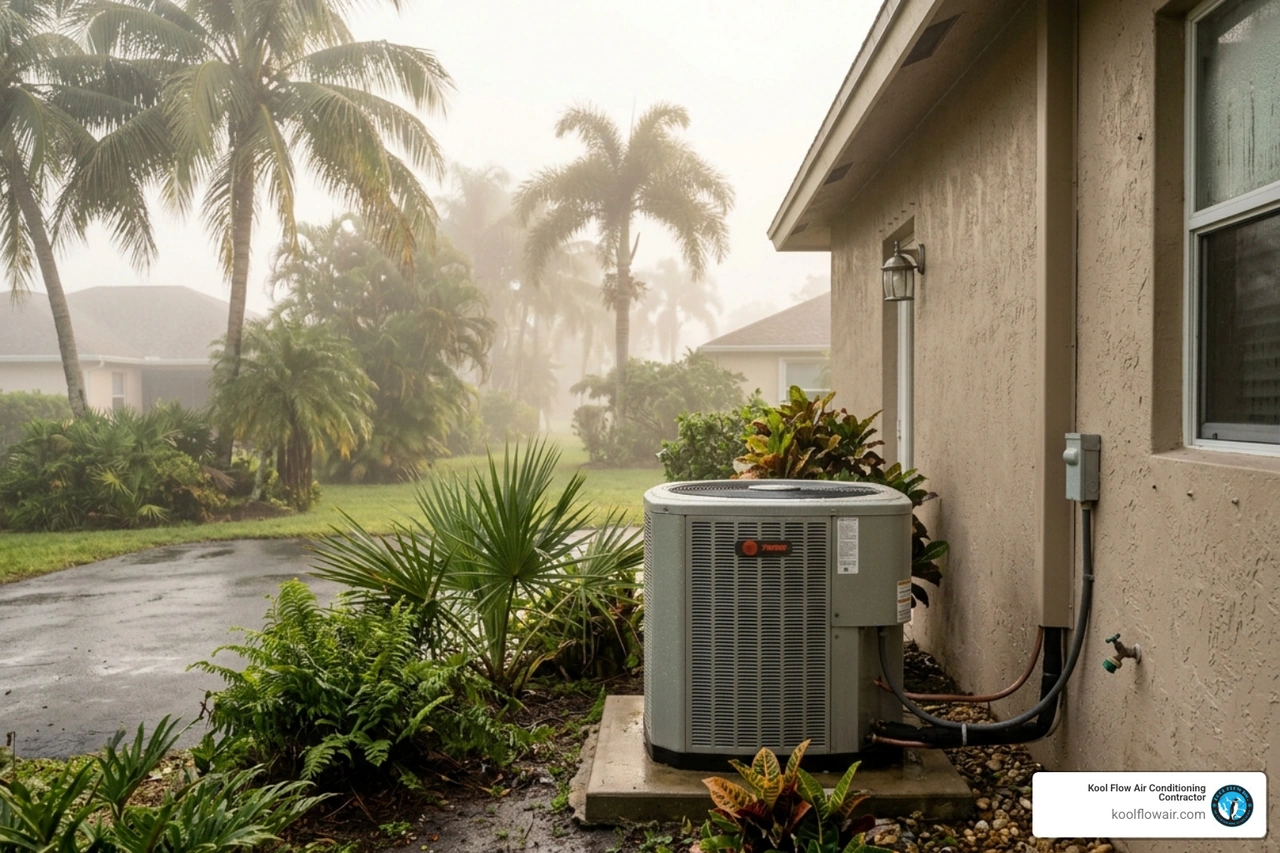
How humidity affects your AC performance is one of the most common — and most misunderstood — problems South Florida homeowners face. When outdoor humidity climbs above 80%, your air conditioner isn't just fighting the heat. It's fighting moisture, too. And that double duty takes a real toll on your system's efficiency, your energy bills, and your comfort at home.
Here's a quick look at the key ways high humidity impacts your AC:
- Your AC has to do two jobs at once — cooling the air and removing moisture from it
- Your home feels hotter than the thermostat shows — high humidity slows your body's ability to cool itself through sweat, making 74°F feel much warmer
- Your AC runs longer and works harder — extended run times put more stress on components and push up your electricity bill
- Musty smells, clammy air, and foggy windows are all signs your system is struggling to keep up
- Short-cycling oversized units cool the air quickly but don't run long enough to pull moisture out, leaving your home cold and clammy
- Long-term wear accelerates — systems in humid climates like South Florida tend to have shorter lifespans than those in drier regions
South Florida's humid subtropical climate means this isn't just a summer problem. From spring through fall, outdoor relative humidity regularly pushes above 80%, putting your AC under near-constant strain. If your home still feels sticky even with the AC running, humidity — not a broken thermostat — is almost always the reason.

To understand why your air conditioner struggles in April 2026, we first need to look at the two types of heat your system has to manage: sensible heat and latent heat. Sensible heat is what you see on the thermometer—it’s the actual temperature of the air. Latent heat, however, is the energy stored in water vapor. In South Florida, latent heat is often the bigger enemy.
When we talk about How South Florida Climate Affects Your HVAC System, we’re really talking about the massive amount of water floating in our air. Your AC removes this moisture through the evaporator coil. As warm, humid air passes over the cold coils, the moisture hits its "dew point" and condenses into liquid water, which then drips into a drain pan.
If the air is too humid, your AC spends most of its energy turning that vapor into liquid instead of actually lowering the air temperature. This is a critical factor in maintaining Indoor Air Quality, as a system that can’t keep up with moisture removal will eventually lead to a home that feels like a swamp.
How Humidity Affects Your AC Performance and Comfort Levels
Have you ever noticed that 75°F feels delightful in a dry climate but absolutely miserable in Fort Lauderdale? That’s the heat index at work. The heat index is a measure of "apparent temperature"—how hot it actually feels to the human body.
Our bodies cool down through sweat evaporation. When the air is already saturated with water, your sweat has nowhere to go. It stays on your skin, leaving you feeling sticky and "muggy." Because you feel warmer, your natural instinct is to crank the thermostat down to 68°F. However, the temperature isn't the problem—the moisture is. Lowering the thermostat just makes the AC run longer without necessarily solving the "sticky air" feeling, leading to a cycle of discomfort and high bills.
The Impact of Latent Load on Cooling Efficiency
In the HVAC world, the "latent load" refers to the amount of moisture the system must remove. When the latent load is high, your cooling efficiency takes a nosedive. Think of it like a car driving uphill while towing a heavy trailer; the engine has to work significantly harder just to maintain the same speed.
High humidity forces longer cooling cycles. Instead of a crisp 15-minute cycle, your unit might run for 45 minutes just to drop the room temperature by two degrees. This massive increase in electricity usage is why we emphasize HVAC Performance Audits & Energy Optimization. Without an efficient way to handle that moisture, your cooling capacity is essentially being "stolen" by the water in the air.
Common Signs Your AC is Overwhelmed by Moisture

If your AC is losing the battle against Florida’s humidity, your home will start "telling" you. One of the most obvious signs is condensation on windows or metal air vents. If you see "sweat" on your windows, it means the indoor humidity is likely well above the recommended 60% limit.
Other red flags include:
- Musty odors: This often indicates that moisture is trapped in your ductwork or on the coils, creating a breeding ground for biological growth.
- Clammy skin: If you feel like you need a shower five minutes after stepping inside, your AC isn't dehumidifying.
- Damp surfaces: In extreme cases, paper may feel limp, and wood furniture might feel slightly tacky to the touch.
If you notice these symptoms, it might be time to look into AC Repair Broward County, FL to ensure your system’s dehumidification components are actually functioning.
How Humidity Affects Your AC Performance and System Lifespan
The constant strain of South Florida humidity doesn't just hurt your wallet; it physically wears down your equipment. When a system has to run twice as long to achieve the same comfort level, every component—from the fan motor to the compressor—ages twice as fast.
This is a major reason why we often discuss How Long Does an AC System Last in South Florida. While a unit in a dry state might last 20 years, a neglected unit in Hollywood or Miramar might tap out after 10 or 12. Learning How to Extend the Life of Your AC in Florida starts with managing the humidity load to prevent premature compressor failure and motor burnout.
Identifying High Indoor Humidity Thresholds
How do you know if your air is actually too wet? We recommend every South Florida homeowner invest in a simple tool called a hygrometer. This device measures the relative humidity (RH) in your home.
Ideally, you want your indoor RH to stay between 45% and 55%. Once it routinely sits above 60%, you are in the danger zone for mold growth and dust mite infestations. Fogged glass and musty smells are "analog" indicators, but Advanced HVAC Monitoring & Predictive Maintenance can give you real-time data to stop a moisture problem before it ruins your drywall or your health.
The Role of System Sizing and Maintenance in Humidity Control
One of the biggest mistakes we see in places like Pompano Beach and Weston is "over-sizing." Many people think that a "bigger" AC will cool the house better. In reality, an oversized unit is a nightmare for humidity control.
An oversized AC cools the air so quickly that it reaches the thermostat’s target temperature in just a few minutes. This is called "short-cycling." Because the system doesn't run long enough, the air never spends enough time on the cold coils for the moisture to condense. The result? A home that is 70°F but feels like a cold, damp basement.
| Feature | Single-Stage AC | Variable-Speed AC |
|---|---|---|
| Cooling Method | All or nothing (On/Off) | Adjusts speeds precisely |
| Humidity Control | Poor (Short cycles) | Excellent (Long, low-speed cycles) |
| Comfort Level | Temperature swings | Consistent & crisp |
| Best For | Budget-conscious | High-humidity climates |
If your current system is the wrong size, you might need to consider AC Replacement Broward County, FL. For some homes, especially those with additions, a Central AC vs. Ductless Mini-Split for Florida Homes comparison might reveal that a zoned approach is better for moisture management.
Why Regular Maintenance is Essential for Dehumidification
Your AC's ability to remove water depends entirely on the cleanliness of its evaporator coils. If those coils are coated in dust or grime, they can't effectively transfer heat or condense water. Instead of dripping into the drain, the water might just blow right back into your air.
What Does an AC Maintenance Visit Include? At Kool Flow, we focus heavily on coil cleaning and airflow checks. A professional AC Tune-Up Broward County, FL ensures that your refrigerant levels are perfect—if they are even slightly off, the coil won't get cold enough to reach the dew point. Knowing How Often Should You Service Your AC in Florida (at least twice a year!) is the best defense against the "sticky house" syndrome.
Preventing Clogged Drains and Algae Growth
When your AC is working hard to remove humidity, it produces gallons of water every day. This water travels through a PVC condensate line. In South Florida’s warmth, this line can quickly become a highway for algae, mold, and "slime."
What Happens If You Skip AC Maintenance in Florida? Eventually, that algae builds up and clogs the line. The water then backs up, either triggering an overflow sensor that shuts your system down or, worse, flooding your home. We recommend a simple vinegar flush every month or two to keep things moving, but a comprehensive AC Maintenance Broward County, FL plan is the only way to ensure your drain pans and safety switches are fully protected.
Practical Solutions to Lower Indoor Humidity Levels
Beyond just maintaining your AC, there are several ways to take the "load" off your system. If your AC is struggling, you don't always need a whole new unit; sometimes you just need better support.
For many homeowners in Davie or Pembroke Pines, the best solution is a whole-home dehumidifier. These units work alongside your AC to pull out moisture even when the cooling cycle isn't running. This allows you to stay comfortable at higher thermostat settings, saving you money in the long run. Whether you choose a Mini-Split vs. Central AC for Humid Climates or stick with your current setup, adding Air Purification, HEPA & Whole Home HVAC upgrades can transform your indoor environment.
Benefits of Whole-Home Dehumidifiers
Why bother with an integrated dehumidifier? Unlike those portable plastic buckets you have to empty every six hours, a whole-home system is tied directly into your plumbing and ductwork.
- Consistent RH levels: It keeps your home at a steady 50% humidity, regardless of the weather in Fort Lauderdale.
- Reduced cooling load: Your AC only has to worry about the temperature, which can extend the life of your compressor.
- Lower energy bills: You’ll feel comfortable at 76°F because the air is dry, meaning your AC runs less.
Our Maintenance Plan customers often find that these systems pay for themselves in reduced wear and tear on the main HVAC unit.
Simple Home Adjustments for Better Control
You can also help your AC by making a few lifestyle changes:
- Use Exhaust Fans: Always run the bathroom fan during and 20 minutes after a shower. Use the kitchen vent while cooking to remove steam.
- Check Your Thermostat Fan Setting: Set your fan to "AUTO," not "ON." If the fan runs constantly, it will blow air over the wet coils after the cooling cycle stops, evaporating all that collected water right back into your home!
- Weatherstripping: Seal leaks around doors and windows. If you can feel the humid air "leaking" in from outside, your AC will never win the battle.
Frequently Asked Questions about Humidity and AC
What is the ideal indoor humidity level for Florida homes?
In the South Florida climate of April 2026, the "sweet spot" for comfort and health is between 45% and 55%. Keeping it below 60% is non-negotiable for mold prevention. If you drop below 40%, you might start noticing dry skin or static electricity, though that’s rare in Broward County!
Does an oversized AC help with humidity?
Actually, it makes it worse. An oversized unit cools the room so fast that it shuts off before it can remove any significant amount of moisture. This leaves you with "cold and clammy" air. Proper load calculations are the only way to ensure your system is perfectly sized for your specific square footage.
Why does my house feel muggy even when the AC is running?
This usually happens for three reasons: dirty evaporator coils, low refrigerant levels, or an oversized system that is short-cycling. It can also be caused by negative air pressure, where your home is actually "sucking" humid outdoor air in through cracks and gaps.
Conclusion
Living in South Florida means accepting that humidity is a part of life, but it doesn't have to be a part of your indoor life. Understanding how humidity affects your AC performance is the first step toward a more comfortable, efficient home. Whether you are in West Park, Hollywood, or Fort Lauderdale, keeping that moisture in check will save you money and keep your family breathing easier.
At Kool Flow Air Conditioning Contractor, we are a family-owned business with over 20 years of experience helping our neighbors beat the Florida swelter. We pride ourselves on honest pricing and reliable cooling solutions. If your home feels more like a sauna than a sanctuary, we’re here to help.
Air Conditioning is more than just a luxury in South Florida—it’s a necessity. Let us help you make sure yours is working as efficiently as possible. Contact us today to schedule a check-up and get your humidity back under control!


Hear what our satisfied
clients have to say

SERVICE AREAS