


The Ins and Outs of How Living Near the Ocean Affects Your AC Lifespan

Why the Ocean Air Around You Is Quietly Shortening Your AC's Life
How living near the ocean affects your AC lifespan comes down to one simple but relentless force: salt air. Here's a quick breakdown:
| Factor | Coastal Impact |
|---|---|
| Average AC lifespan | 8–12 years (vs. 15–20 years inland) |
| Oceanfront units | Can fail in as little as 5–7 years |
| Corrosion rate | 4–8x faster than inland environments |
| Annual run hours | 2,500–3,500 hrs (vs. 1,000–1,500 inland) |
| Humidity levels | 70–85% for most of the year in South Florida |
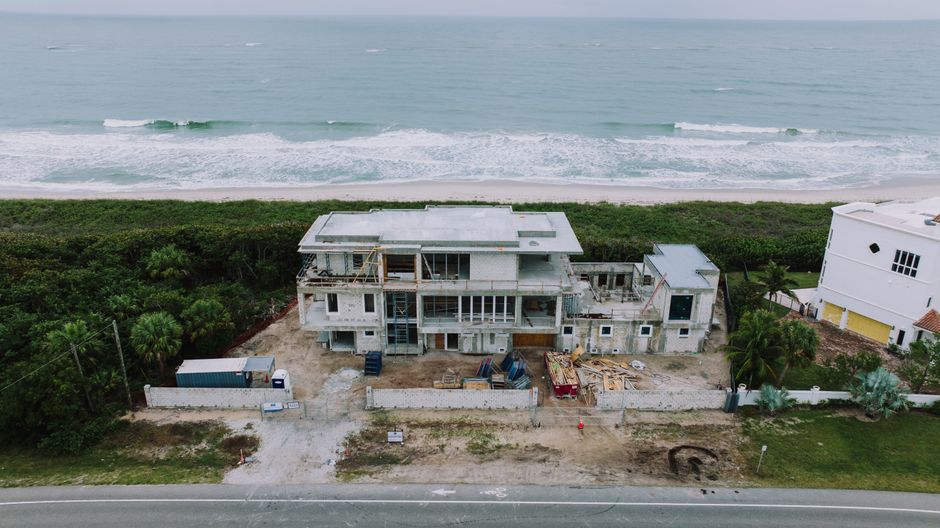
If you own a home in South Florida — from Fort Lauderdale to Miami, or anywhere along the Broward or Miami-Dade coastline — your AC system is working under some of the most punishing conditions in the country. The same salty ocean breeze that makes coastal living so appealing is also landing on your outdoor condenser unit every single day, triggering a slow but steady chemical attack on its metal components.
Salt particles combine with the region's consistently high humidity to corrode aluminum fins, copper tubing, and electrical connections at a rate far beyond what a standard AC unit is designed to handle. The result? Systems that should last 15 to 20 years often show serious wear within 8 to 10 years — and oceanfront units can decline even faster without the right protection.
This guide covers everything South Florida homeowners need to know: the science behind salt air damage, what warning signs to watch for, and the most effective ways to protect your investment.
The Science Behind How Living Near the Ocean Affects Your AC Lifespan
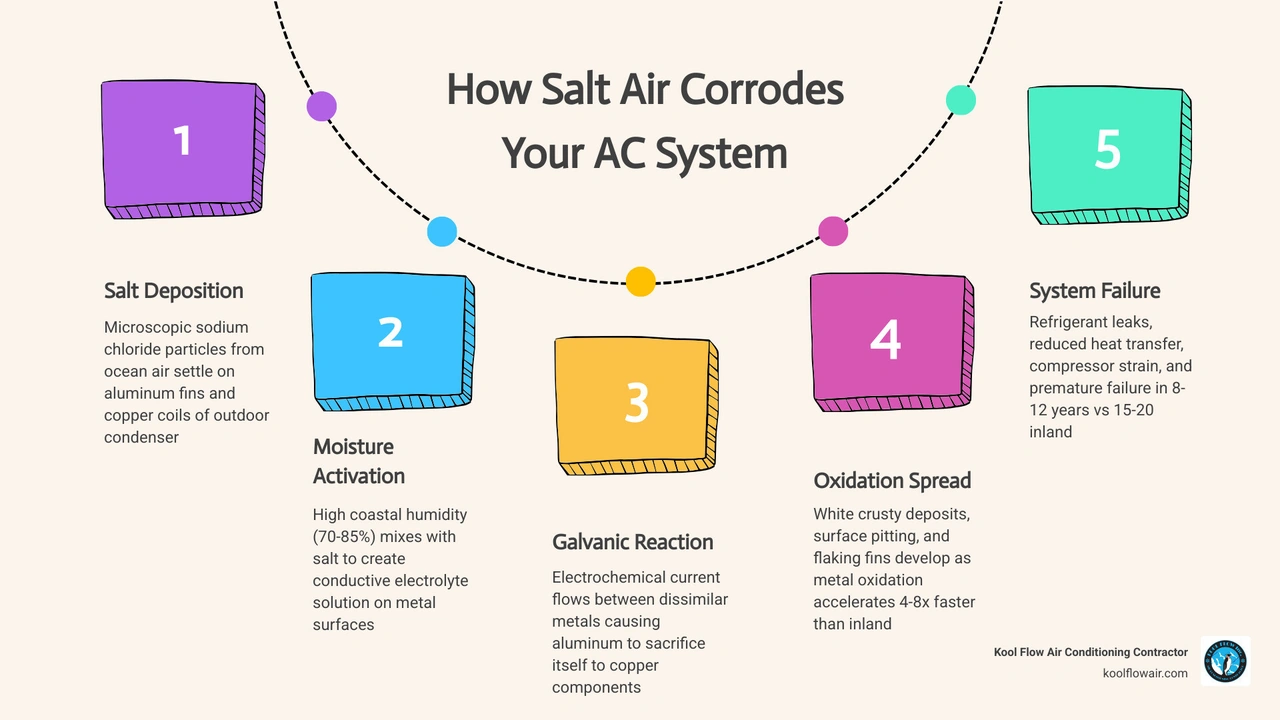
To understand why your air conditioner struggles in places like Pompano Beach or Lauderdale-By-The-Sea, we have to look at the chemistry of the coast. The primary culprit is sodium chloride—common sea salt. These microscopic particles are carried by the wind and settle on every surface of your outdoor unit.
Once these particles land, they don't just sit there. They initiate an electrochemical reaction known as galvanic corrosion. In a standard AC unit, you have different types of metal in close contact, specifically aluminum fins and copper tubing. When salt and moisture are added to the mix, they create an "electrolyte solution." This solution allows electrons to flow between the metals, causing the aluminum to "sacrifice" itself to the copper. This leads to the rapid oxidation and eventual disintegration of the metal.
Understanding how does salt air affect your HVAC system is the first step in realizing that this isn't just "wear and tear"—it is a constant chemical battle occurring right outside your window.
Why Salt Air and Humidity are a Dangerous Duo
Salt on its own is bad, but salt combined with South Florida’s humidity is a catastrophe for machinery. In areas like Hollywood and Hallandale, the relative humidity regularly sits between 70% and 85%.
There is a critical threshold at 65% relative humidity. Once the air stays above this level, moisture attraction to salt particles increases significantly. Salt is hygroscopic, meaning it literally pulls water out of the air. This keeps the metal components of your AC unit damp for longer periods, even when it hasn't rained. This constant moisture accelerates oxidation, leading to a much higher volume of condensate production and putting a massive strain on the system's ability to shed heat. You can learn more about how humidity affects your AC performance to see how this moisture trap forces your system to work overtime.
Proximity to the Shoreline and Deterioration Rates
Not all coastal homes are affected equally. We generally categorize the most "high-exposure zone" as anything within 1,500 feet of the high-tide line. If you live directly on the beach in Hillsboro Beach or Deerfield Beach, your unit is in the direct line of fire for salt spray.
However, don't think you're safe just because you're a mile inland in Margate or Coral Springs. Onshore breezes can carry salt particles several miles inland. The orientation of your home also matters; a "windward" placement (facing the ocean) will see significantly faster deterioration than a "leeward" placement (shielded by the house). Understanding how coastal weather impacts HVAC performance helps explain why two identical units installed on the same day can have vastly different lifespans based solely on their physical location.
Comparing Lifespan: Coastal vs. Inland AC Systems
The data is quite clear: geography is destiny when it comes to HVAC longevity. While a homeowner in a landlocked state might enjoy 20 years of service from a central AC unit, South Florida residents have to be more realistic.
| Location | Typical Lifespan | Primary Stressors |
|---|---|---|
| Inland (Non-Coastal) | 15–20 Years | Dust, seasonal use |
| South Florida (General) | 10–15 Years | Heat, 80% humidity |
| Coastal (Within 5 miles) | 8–12 Years | Salt air, high run hours |
| Oceanfront (Direct) | 5–7 Years | Salt spray, constant corrosion |
A major factor here is the annual run hours. In northern states, a system might run for 1,000 to 1,500 hours a year. In Broward and Miami-Dade counties, our systems often log between 2,500 and 3,500 hours annually. This "component fatigue" means that by the time a coastal unit is 8 years old, it has effectively done the work of a 20-year-old inland unit. For a deeper dive into these timelines, check out our guide on how long does an AC system last in South Florida.
Warning Signs of Salt Air Corrosion on Your AC
How do you know if the salt is winning? There are several tell-tale signs:
- White Crusty Deposits: This is the early stage of salt accumulation and oxidation.
- Surface Pitting: Small "pockmarks" appearing on the metal casing or coils.
- Flaking Fins: If the thin aluminum fins on your condenser start to crumble like dry crackers when touched, the metal has lost its structural integrity.
- Lukewarm Airflow: As coils corrode, they lose their ability to transfer heat, leading to air that isn't as cold as it used to be.
- Rising Energy Bills: A corroded system has to run longer to achieve the same cooling effect.
Seeing these signs often indicates that how Florida heat and humidity affect AC lifespan is taking a toll on your specific unit, and it may be time for a professional assessment.
How Living Near the Ocean Affects Your AC Lifespan and Efficiency
Efficiency is the first thing to go when salt takes hold. Your AC works on the principle of heat transfer. The outdoor coils are designed to release the heat collected from inside your home. When salt and corrosion build up, they create a layer of "thermal resistance."
This forces the compressor to work much harder and run for longer cycles. Even a high-efficiency SEER2 rated unit will quickly lose its efficiency advantage if the coils are caked in salt. This "system overworking" doesn't just cost you more in monthly utilities; it leads to premature failure of the compressor and fan motor—the most expensive parts to replace.
Best Practices to Protect Your Coastal AC Investment
The good news is that you aren't helpless. There are proven ways to fight back against the salt.
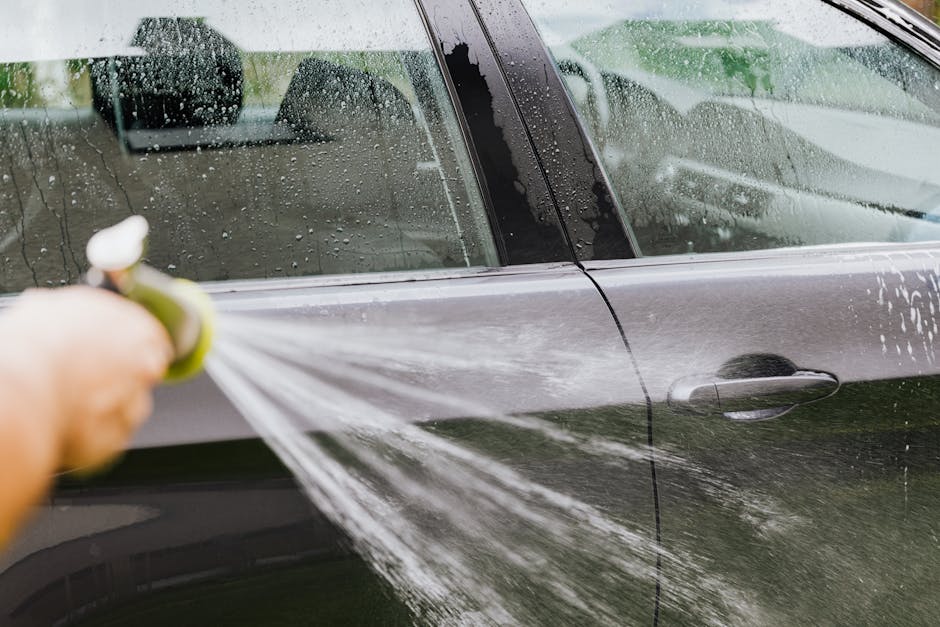
Freshwater Rinse: Your Best DIY Defense
The single most effective thing you can do is perform a regular freshwater rinse. Using a standard garden hose with low pressure, gently wash down the outdoor condenser unit. This removes the salt film before it has a chance to trigger a chemical reaction. Do not use a power washer, as the high pressure can easily bend the delicate aluminum fins, doing more harm than good. Consistency is key here; learning how to extend the life of your AC in Florida starts with this simple 5-minute task.
Protective Coatings and Marine-Grade Components
For those living in high-exposure areas like Lauderdale-By-The-Sea or Sunny Isles, standard units may not be enough. You should look into specialized protective coatings.
- Phenolic Epoxy Coatings: These are factory-applied or field-applied coatings that create a barrier between the metal and the salt air.
- Polymer Coatings: Similar to epoxy, these provide a flexible shield for the coils.
- Marine-Grade Materials: High-end coastal units often feature stainless steel hardware and specialized "triple-phase" protection to resist rust.
Strategic Installation for Coastal Homes
Where you place your unit can add years to its life. If we are installing a new system in a place like Weston or Pembroke Pines, we look for natural shielding.
- Wind Barriers: Using a fence or shrubbery (while maintaining at least 2 feet of clearance for airflow) can block direct salt spray.
- Rainwater Cleansing: Positioning the unit so it receives natural rainwater can actually help wash away salt, provided it isn't tucked under a tight eave.
- Elevated Platforms: Keeping the unit off the ground prevents salt-laden moisture from the soil and heavy ground-level salt spray from settling on the base.
Our AC maintenance Fort Lauderdale tips 2026 emphasize that strategic placement is just as important as the model you choose.
Choosing the Right Unit for Oceanfront Living
If you are shopping for a new unit in South Florida, look for "Coastal Rated" models. These units are built differently. They typically feature:
- Coated Coils: Often referred to as "Seacoast" or "Gold" coils.
- Minimal Soldering: Solder points are weak spots where leaks often start in salty environments.
- Stainless Steel Fasteners: To prevent the cabinet from rusting and falling apart.
- E-Coating: An electro-deposition coating that ensures 100% coverage of the coil surface.
The Role of Professional Maintenance in Salty Environments
While DIY rinsing is great, it cannot replace professional care. In a coastal environment, maintenance isn't a luxury—it’s a rescue mission.
A professional tune-up in South Florida should happen at least twice a year. We perform deep coil degreasing to remove salt that a garden hose can't reach. We also conduct early leak detection; salt corrosion often causes "pinhole" leaks in copper tubing that are invisible to the naked eye but will slowly kill your system.
Skipping these visits is risky. If you want to know the consequences, read about what happens if you skip AC maintenance in Florida. Our NATE-certified technicians also test electrical components, which are highly susceptible to "pitting" and failure when exposed to the salt-laden marine layer.
Frequently Asked Questions about How Living Near the Ocean Affects Your AC Lifespan
How often should I rinse my outdoor AC unit if I live near the beach?
If you live within a mile of the ocean, we recommend a freshwater rinse once a week. If you are 1 to 5 miles inland, once or twice a month is usually sufficient. Always do this after a major windstorm or hurricane, as these events carry massive amounts of salt spray inland.
Does a standard manufacturer warranty cover salt air corrosion?
Generally, no. Most manufacturers classify salt air corrosion as "environmental damage" or an "act of nature," similar to flood or storm damage. This is why being proactive is so important. Some brands offer specific coastal warranties, but these often require documented proof of regular professional maintenance to remain valid.
Can I use a cover to protect my AC from salt air?
Be very careful here. Standard plastic or non-breathable covers are actually dangerous for your AC. They trap humidity and salt inside the unit, creating a "sauna effect" that accelerates corrosion even faster. If you must use a cover, it must be a breathable, marine-grade mesh specifically designed for HVAC units—and you must never run the AC while it is covered.
Conclusion
Living in South Florida offers a lifestyle that is second to none, but it requires a different approach to home maintenance. How living near the ocean affects your AC lifespan is a reality we all have to face, but with the right knowledge and a proactive plan, you can keep your home cool and your system running for its full intended life.
At Kool Flow Air Conditioning, we are South Florida HVAC experts with over 20 years of experience serving Broward, Miami-Dade, and Palm Beach Counties. As a family-owned business based in West Park, we understand exactly what the salt air does to units in Fort Lauderdale, Hollywood, and beyond. Whether you need a coastal-rated installation, a deep salt-removal cleaning, or a reliable maintenance plan to protect your investment, we are here to help.
Don't let the salt air win the battle. Contact us today to ensure your system is ready to handle the unique demands of our beautiful coastal climate. For more information on our local environment, read our guide on how South Florida climate affects your HVAC system.


Hear what our satisfied
clients have to say

SERVICE AREAS